Zomalex | Data and AI Training
Machine Learning With Python Course
Machine Learning (ML) is a fundamental discipline in Artificial Intelligence (AI). ML allows us to train computers to do tasks without explicit programming e.g. classifying images into certain categories. Often such tasks would be impossible to program in any case.
This is a very practical course where students will build and test ML models in guided tutorials based on publicly available datasets. The course starts with simple models and gradually progresses to more sophisticated and powerful ones.
Who Should Attend
This course is for Python developers who have completed the foundation and intermediate courses and want to apply their skills to machine learning.
Learning Objectives
By the end of this course, attendees will be able to build, train, evaluate and deploy machine learning models using Python libraries such as scikit-learn and keras.
Course Content
Introduction to ML
This covers the basic concepts in ML and includes:
- examples of real world ML applications;
- terms used in ML: e.g., datasets, features and labels; train test and evaluate models.
- supervised vs unsupervised approaches;
- regression vs classification techniques;
Prepare data for ML
What sort of data do we need to build a model? Data collection, size, quality…
Prepare data for use in ML models (feature engineering) e.g., improve data quality, change variables from text to numbers (one-hot encoding)
ML algorithm families – a quick tour
The first step in building a model is to choose the algorithm that we will use. There are several families of these algorithms including:
- Linear methods
- Decision trees
- KNN clustering
- Deep learning (neural nets) We will have a quick look at each of these, with a short Python script to demonstrate their use.
Build a model
We will discuss the process for building and testing a model over the course of several exercises. The main steps are:
- split the data into training and test datasets;
- fit the model to the training dataset;
- evaluate the model performance (how good and accurate it is) with the test data and techniques such as confusion matrix; and
- deploy the model into production.
Python libraries used in ML
During the guided exercise we will use a few popular Python libraries for ML. These include:
- scikit-learn, a library that provides simple and efficient tools for data mining, data analysis and ML
- keras, a high-level neural networks API, written in Python and capable of running on top of TensorFlow (which is an open-source machine learning framework developed by Google, renowned for its flexibility and support for deep learning and neural networks)
- numpy, a package for data manipulation which underpins many Python ML libraries. It supports large arrays and matrices, and a set of mathematical functions to operate on these.
Course Length
2 days
Pre-requisites
Completion of the Python foundation and intermediate courses.
Snapshots from the course exercises
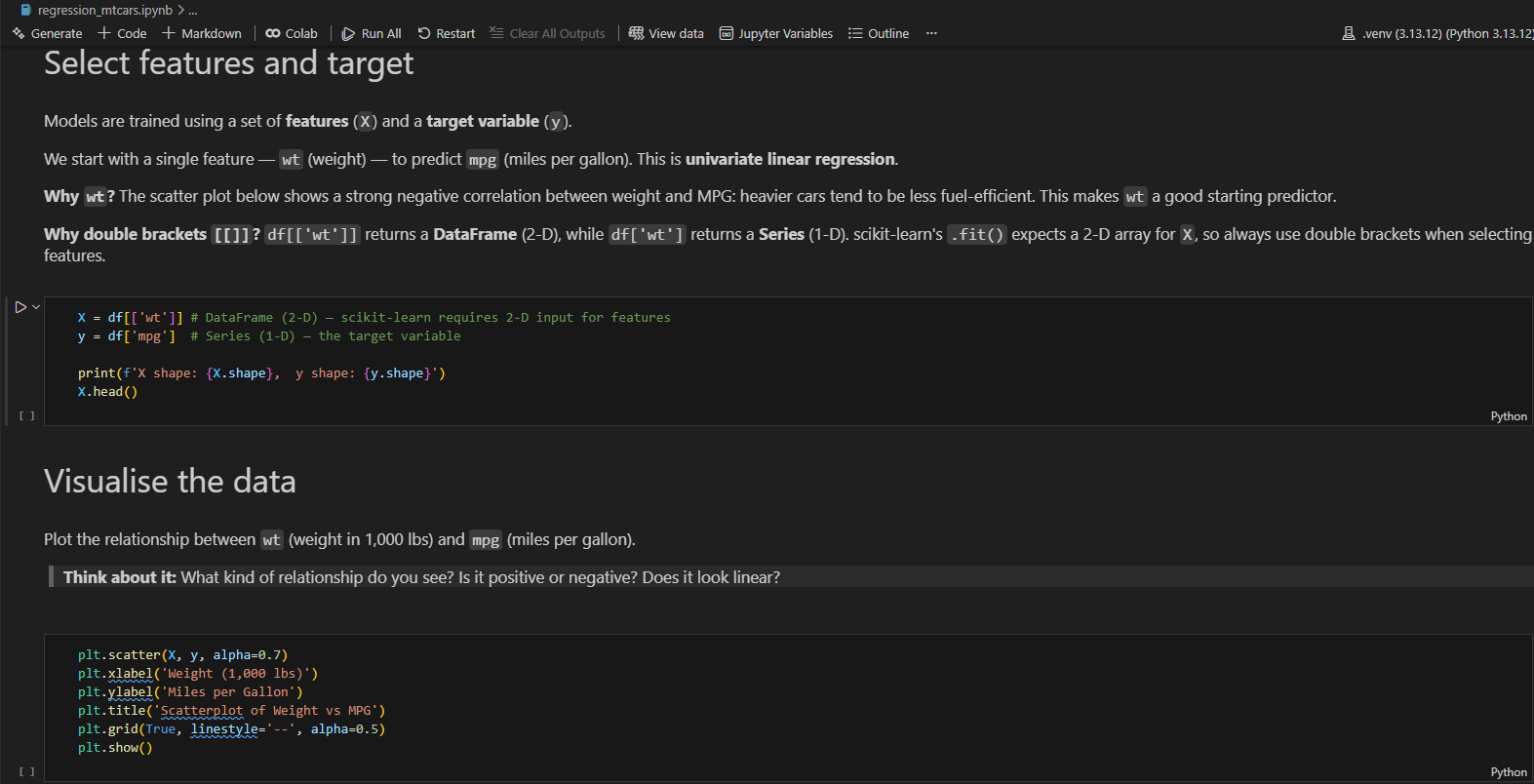
Part of the lesson on building a linear model